Oral History Interview – Elizabeth Chipman
Elizabeth Chipman interviewed by Ian Toohill and Kevin Shepherd
Compiled and edited by Alan Ryan
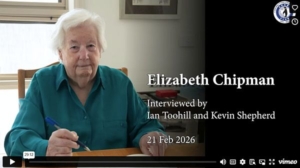
Audio interview with Elizabeth Chipman conducted by Ian Toohill and Kevin Shepherd 21 Feb 2026
The latest instalment in our “Oral Histories” series. Ian Toohill and Kevin Shepherd interviewed Elizabeth Chipman on 21 February 2026.
Elizabeth joined the Australian Antarctic Division in 1954, initially as a typist and later as information officer and scientific administrator.
Of historical significance Elizabeth Chipman was one of the first four women on the Antarctic Continent as a member of ANARE, visiting Casey during the 1975-76 Summer.
Elizabeth travelled as AAD Representative on voyages to:
- Macquarie Island, 1966-67 Summer
- Macquarie Island, 1971-72 Summer
- Macquarie Island, 1975-76 Summer
- Casey and Macquarie Island, 1975-76 Summer
Elizabeth became the first woman member of the ANARE Club in 1971. Her contributions included typing many of the early editions of the club’s flagship Aurora journal.
After retiring from the Australian Antarctic Division in 1977, Elizabeth published Australians in the Frozen South: Living & Working in Antarctica, 1978. The book paid tribute to early Antarctic explorers and expeditions prior to ANARE, introduced the programs undertaken by ANARE, described the experience of living and working in Antarctica, introduced the science programs and the Antarctic Treaty. The book was a guide to the day-to-day activities of expeditioners that was especially appreciated by the families of expeditioners during their absence.
In 1986 Elizabeth published another important documentary work, Women on the Ice: A History of Women in the Far South. It was the result of extensive research into the women who had supported or taken part in earlier expeditions with little acknowledgement or recognition from as early as 1766. Elizabeth’s work celebrates women who pioneered the wider involvement of women in Antarctic programmes as recently as only a few decades ago. The book became a reference that is still cited in literature on women’s achievements.
See other Audio Interviews with ANARE Expeditioners.