The ANARE Club is proud to have managed the design, funding and dedication of the grave monument for
Captain John King Davis CBE
dedicated at the Melbourne General Cemetery on 19 February 2026
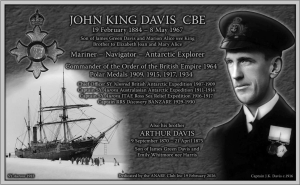
Download final plaque proof PDF
Plaque text:
JOHN KING DAVIS CBE
19 February 1884 – 8 May 1967
Son of James Green Davis and Marion Alice nee King
Brother to Elizabeth Joan and Mary Alice
Mariner – Navigator – Antarctic Explorer
Commander of the Order of the British Empire 1964
Polar Medals 1909, 1915, 1917, 1934
Chief Officer Nimrod British Antarctic Expedition 1907-1909
Captain SY Aurora Australasian Antarctic Expedition 1911-1914
Captain SY Aurora ITAE Ross Sea Relief Expedition 1916-1917
Captain RRS Discovery BANZARE 1929-1930
Also his brother
ARTHUR DAVIS
9 September 1870 – 21 April 1875
Son of James Green Davis and
Emily Whitmore nee Harris
Dedicated by the ANARE Club Inc 19 February 2026
Plaque images:
(Left) The ship Aurora anchored to floe-ice off the West Base, Shackleton Ice Shelf, Australasian Antarctic Expedition, 1913, by Frank Hurley, plate glass negative, State Library of New South Wales, ON 144/H485
(Right) Captain John King Davis, c.1916, wearing two Polar Medals: bronze Antarctic 1907-09 and silver Antarctic 1912-14. Photo by Swaine Studios, now held by and used with permission from the Australian Antarctic Division.
The J.K. Davis grave monument project
Given the honour in which Captain Davis’s reputation and contribution to Australian Antarctic history is universally held, in August 2023 it was a shocking surprise to learn that his grave at the Melbourne General Cemetery (MGC) was unmarked and generally unknown.
This information was provided by a member of the public (and now ANARE Club member) Alison Hutchison. Alison had read Davis’s autobiography High Latitude, been deeply impressed by his life and achievements, and had tracked down his grave while on a visit to Melbourne. She had been surprised to find that this man, who had achieved so much, did not have a grave monument at all, let alone one that honoured his life. A patch of bare earth was all that covered his mortal remains.
Some years later Alison contacted the ANARE Club through our website to alert us to this fact. As Club members will be aware, the Club immediately took up Alison’s suggestion that we rectify this situation. And so began a two-and-a-half year project which came to a successful and memorable conclusion on the 142nd anniversary of Captain John King Davis’s birth.
After discovering that Captain Davis had been buried with his young half-brother Arthur, it was decided early on that any monument to Davis must include reference to Arthur as his brother and co-occupant of the grave plot.
Getting official permissions for the grave monument was an administrative challenge. The MGC records show James Green Davis as the owner of the grave and cemetery regulations state that all changes to a grave must be approved by the grave owner. This was a problem almost a century after Davis senior’s death in 1926. Fortunately, grave ownership is considered to pass through the family line so with Alison’s help we tracked down Mrs Elizabeth Lynch, granddaughter of Elizabeth Joan Holden, Captain Davis’s elder sister, who had moved to and married in South Africa. The MGC was willing to accept that ownership of the grave had passed down from James Green Davis to Mrs Lynch and, with the help of her husband Des Lynch, both of whom still live in South Africa, we were able to get the necessary authorities and cemetery approvals to allow a grave monument to be designed and installed.
The next task was designing the grave monument and finding a monumental mason to create it. Knowing that Davis was a man of few words and careful habits – and that he had not left instructions or funds for a grave monument, despite having had the monetary means to do so – we felt that a dignified but unostentatious stone grave monument would best reflect the man himself while paying tribute to his life and achievements and acknowledging the honour in which he is held. There was also a need to blend in with the surrounding grave monuments dating back to the 1870s. After getting a range of quotes, in October 2024 the ANARE Club National Council appointed A.C. Addison & Sons, a fourth-generation monumental masonry company, as the company to assist with this important task. Jason Addison and his Melbourne-based manager Christine have been extremely supportive of this project throughout: it is principally to Jason that we owe the innovative and evocative design of the grave’s plaque.
The grave monument and the stone composing it were chosen carefully to fit in with surrounding graves while also paying tribute to John King Davis and his life. The grave kerb – the grey perimeter stone – is sawn granite, closely resembling the bluestone of the nearby grave monuments. The ledger (stone top) of the grave is a polished granite slab including white, grey-silver and black flecks. And finally, the desk (the stone wedge supporting the plaque) is polished black granite. All three stones were selected to echo the colours of the landscape and geology around Davis station, particularly its famous dykes of black dolerite.
In keeping with the monochromatic colours of the stone choices, the plaque has been cast in aluminium to give it a silver appearance, rather than the gold-brown of a more common bronze plaque. The plaque text was composed and repeatedly checked from Australian and British government records to ensure accuracy of dates and events. The grave monument was installed in January and February 2026 and dedicated in a graveside ceremony on 19 February 2026.
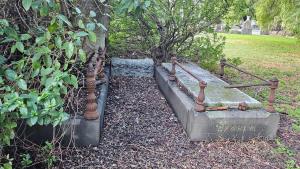
Grave of Captain J.K. Davis at the Melbourne General Cemetery, June 2025
Photo by Denise Allen
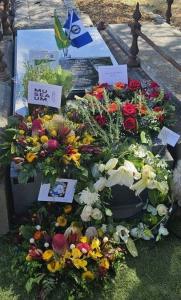
Grave of Captain Davis 19 February 2026 after the rededication ceremony.
Photo by Melanie Van Twest
The re-dedication Gravesite Ceremony and Service of Remembrance Booklet can be viewed by Members
History of Captain J.K. Davis
John King Davis was born in Kew in England on 19 February 1884, the second child and first son of James Green and Marion Alice Davis. After a grammar school education, in 1900 the 16 year-old Davis and his father sailed to South Africa and soon after he ran away to sea, signing up as a steward’s boy on the steamer Carisbrooke Castle. By 1907 Davis had sufficiently progressed in age, knowledge and experience to be appointed as the Chief Officer on Sir Ernest Shackleton’s Nimrod Expedition and departed for Antarctica for the first time in August of that year. During this expedition he formed a firm and life-long friendship with geologist Douglas Mawson. Mawson was accompanying Shackleton’s expedition as part of a side-quest to reach the South Magnetic Pole, along with T.W. Edgeworth Davis and Alistair McKay, which goal was successfully achieved on 16 January 1909. In 1909 Captain Davis was awarded the Polar Medal (Bronze) for his part in the Nimrod expedition. 
In 1911 Davis was appointed Captain of the SY Aurora, the ship with which he is most closely associated and for which he retained the fondest memories. By now Mawson had raised sufficient funds to mount his own expedition and the Australasian Antarctic Expedition (AAE) set sail on 2 December 1911 for Macquarie Island and then for Commonwealth Bay on the coast of Antarctica on board the SY Aurora, with Davis as second-in-command. Between 1911 and 1914 Davis and his crew made five AAE voyages managing uncharted coastlines, difficult and dangerous weather conditions and problems with the ship as well as the difficulties faced by the expedition itself. For his contribution to the AAE Captain Davis was awarded the Polar Medal (Silver) in 1915.
Davis returned to Antarctica on board the SY Aurora once again in October 1916 on behalf of the British, Australian and New Zealand governments, with Shackleton as supernumerary. This was the Imperial Trans-Atlantic Expedition (ITAE) Ross Sea Relief Expedition, mounted to rescue Shackleton’s ‘shore party’ left at McMurdo Sound to support their leader’s epic (but ill-fated) attempt to cross Antarctica from the Weddell Sea. After being marooned for two winters with inadequate supplies and equipment, the last members of the ITAE safely reached New Zealand in the Aurora on 9 February 1917. In 1917 Davis was awarded a second clasp to the Polar Medal (Bronze) for his part in these efforts.
On either side of the Ross Sea Relief Expedition, during World War I Davis spent time in the Royal Australian Naval Reserve transporting soldiers and horses to England and Egypt and repatriating troops after the War. He then undertook a number of private and public roles including becoming the Commonwealth Director of Navigation in 1920, which post he retained until his retirement in 1949. Davis also worked to establish the cyclone warning station on remote Willis Island in 1921, spending six months on the island himself. He spent 15 years on the committee advising the Australian Government on Antarctic policy and was a long-term Council member of the Royal Society of Victoria and President in 1946 and 1947.
In 1929-30 Davis returned to Antarctica for the final time as Captain of the RRS Discovery on the British, Australian and New Zealand Antarctic Research Expedition (BANZARE), once again in company with Douglas Mawson. BANZARE laid the groundwork for establishing the future Australian Antarctic Territory through multiple territorial claims as well as scientific work in a range of fields including geology, meteorology and oceanography. Davis received a third clasp to the Polar Medal (Bronze) for his part in this expedition.
Through these experiences Davis gained a reputation as one of the most capable and reliable Antarctic sea-captains, if one considered a little dour and reserved. “Gloomy” was his well-deserved nickname and his tall, red-headed figure was well known in Government and Antarctic circles. Later in life he had close relationships with his Australian-based family and was known to have an excellent sense of humour. Davis was immensely trusted and respected in many fields and his reputation as the greatest master-mariner of the Heroic Age – and since – only continues to grow.
John King Davis never married and had no children. He lived his latter years in a comfortable boarding house for single gentlemen in Toorak, a well-to-do suburb of Melbourne, and published his autobiography, High Latitude, in 1962. He died on 8 May 1967 in hospital and was buried in the Melbourne General Cemetery (MGC) on 10 May 1867 in the grave of his half-brother, Arthur.
References and further information:
John King Davis (1884-1967) – Australian Antarctic Division website
John King Davis (1884-1967) by John Bechervaise – Australian Dictionary of Biography, 1981
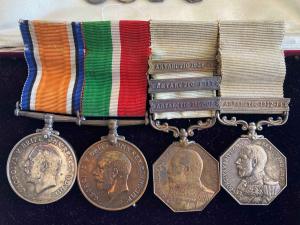
Medals of Captain John King Davis CBE. The two Polar Medals are on the right.
His CBE Medal is not included and its current whereabouts are being researched.
Photo by Melanie Van Twest
History of Arthur Davis
The knowledge that Captain Davis’s grave was shared by another burial only came to light when investigation into this project began. The Melbourne General Cemetery (MGC) advised us that the grave was also occupied by Arthur Davis who was buried on 22 April 1875.
Subsequent investigation into Births, Deaths and Marriages archives for the Colony of Victoria revealed a previously little-known fact: that Davis’s father, James Green Davis, had lived, worked, married and had a family in Melbourne in the 1860s and 1870s.
The elder Davis was an Irish teacher from County Cork who married Emily Whitmore (nee Harris) in October 1868, Emily being described as ‘widow’ and ‘milliner’ in their marriage record. They had two known children. In a sad but not uncommon story for the time, all three of Davis senior’s first wife and children died prematurely: little Emily Rose in November 1869 at three months and Arthur in 1875 at four-and-a-half years. The fate of Emily Davis senior is so far unknown and is under research.
From her death certificate it is known that Emily Rose is buried elsewhere in the MGC. Her grave site is to be investigated. As a small baby, she may have been interred in a collective grave with other babies as a lower-cost option for burial.
The grave plot at the MGC had therefore been purchased by James Green Davis to bury his son Arthur, whose death certificate states that he died of typhoid and measles aged four-and-a-half on 21 April 1875. John King Davis clearly knew about the MGC grave, electing to be buried there himself in 1967, almost a century after his small half-brother’s death, thus connecting the brothers in love and memory.
After the loss of his first family James Green Davis returned to Britain where he married Marion Alice King in 1881 and with whom he had three children: Elizabeth Joan (born 1881), John King (born 1884) and Mary Alice (born 1886). All three children from his second marriage survived to adulthood.
References:
Places named in honour of JK Davis
- Davis Station, Vestfold Hills, Ingrid Christensen Coast
- Cape Davis, Kemp Land
- Davis Bay, Wilkes Coast
- Davis Peninsula, Queen Mary Land
- Davis Sea, between the Shackleton Ice Shelf and the West Ice Shelf
- Davis Dome, Heard Island
- Davis Point, Macquarie Island
- Davis Bay, Macquarie Island
Connection to Davis Research Station
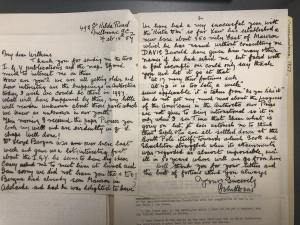
On 15 February 1957 John King Davis sent a letter to his friend and colleague, Hubert Wilkins, in which he wrote:
My dear Wilkins,
Thank you for sending me the two I.G.Y. [International Geophysical Year] publications and the map. I found much to interest me in them.
How are you? We are all getting older and how interesting are the happenings in Antarctica. I wish we could be there in 1997. What will have happened by then, very little will remain unknown about those parts which we knew as unknown in our youth.
This morning I received the paper Pioneer you look very well and are evidently in good shape. Well done! ….
We have had a very successful year with the “Kista Dan” so far Law has established a new base about 350 miles East of Mawson which he has named without consulting me DAVIS. I could have given him many other names if he had asked me, but faced with a fait accompli one could only say thank you and let it go at that. [emphasis added]
“At 17 many their fortunes seek / At 73 [it] is too late a week” seems applicable it is taken from “As you like it.” ….
Well thank you for your letters and the best of fortune attend you always
Yours Sincerely
John K Davis
In this remarkable letter Captain Davis rather casually records his experience of having the second Australian continental station named in his honour. One suspects that ANARE Director Dr Phillip Law deliberately decided to inform, rather than seek permission from, Davis about this naming, noting that Davis’s immediate reaction was to think of others who he felt would be more deserving. But Davis was undoubtedly proud to be honoured in this way and to be associated with his great friend and collaborator, Sir Douglas Mawson, as the second Antarctic expeditioner and explorer to have a namesake Australian research station on the icy continent.
Located at 68° 34′ 35″ S, 77° 58′ 08″ E (−68.5763, 77.9688), Davis Research Station is the most southerly of the Australian Antarctic stations and was officially opened on 13 January 1957, a month before Davis’s letter to Wilkins. The location is rocky and the nearby ice-free Vestfold Hills are streaked with veins of the black dolerite for which Davis Station is particularly known.
References
- Australian Antarctic Division – Davis Station
- Davis Station News
- Davis Station – Wikipedia entry
- Letter image reproduced courtesy of the Polar Archives, Ohio State University, Columbus OH and with thanks to Philip van Dueren
Thank you to all our Contributing Donors
Gold Donors ($500 or more)
 ANMM (Australian National Maritime Museum) – MMAPSS00033 – incl floral tribute
Jim Spinks
Peter Stickland
Douglas Pocock
Kate Mulligan-Schneeberger Family – incl floral tribute
ANARE Club Inc – incl Living floral tribute (donated to MGC-Project Cultivate program for planting in the vicinity of the gravesite)
Bronze Donors
Ian Bird
Max Corry
Philip Barnaart
Robert Nash
Philip Tuckett
Barry Balkin
Helen Beggs
Paquita Boston
Colin Christiansen
Patricia Burgess
Morris Pavlinovich
Alison Hutchison
Gwennyth Campbell-Drury and Family
Davis Station 79th ANARE expeditioners – floral tribute
SERCO/Nuyinya crew – floral tribute
Comments received during Member Donation campaign
From Paquita Boston on 20/11/2025 15:45
JKD (Gloomy) was Mum’s godfather and I know she would be pleased about the memorial for him. I only met him once, very briefly, when I was a teenager, but I enjoy reading about his seafaring adventures.
From Robert Nash on 10/11/2025 11:07
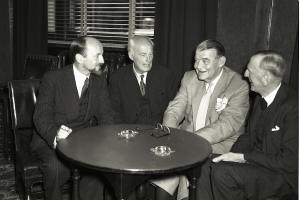
Law, Mawson, Riser-Larsen, J.K.Davis met at Federal Hotel, Collins St. Melbourne in 1954.
Just thought I thought I’d send you copy of this photo which links Phil Law and ANARE with Mawson and Davis, no doubt you have seen before.
The direct link with ANARE emphasises how appropriate the Club attend to J.K.D’s grave-site.
Law, Mawson, Riser-Larsen and Davis meeting at the Federal Hotel, Collins Street, Melbourne in 1954.
On 02/12/2025 08:39, Trish Burgess wrote:
JK Davis and my Grandfather, Donald Eadie, were long term friends. My Grandfather was Manager of Williamstown Dockyard from 1928 to 1938, when he moved to Sydney. They kept in touch until my Grandfather’s death in 1962. Both born in England they lived much of their lives in Australia. I have quite a lot of memorabilia given to my grandparents by Davis.
On 02/02/2026 21:20, Rick Campbell-Drury wrote:
My Mother, Gwennyth is 95 and her husband (my Father) was Alan Campbell-Drury. My Father knew Captain Davis very well. Mum recalled when I was born that Captain Davis left chocolates for her and at the Mercy Hospital where I was born.